
Live at the Counter Eurovision '79

“without the knowledge of your history you cannot determine your destiny”

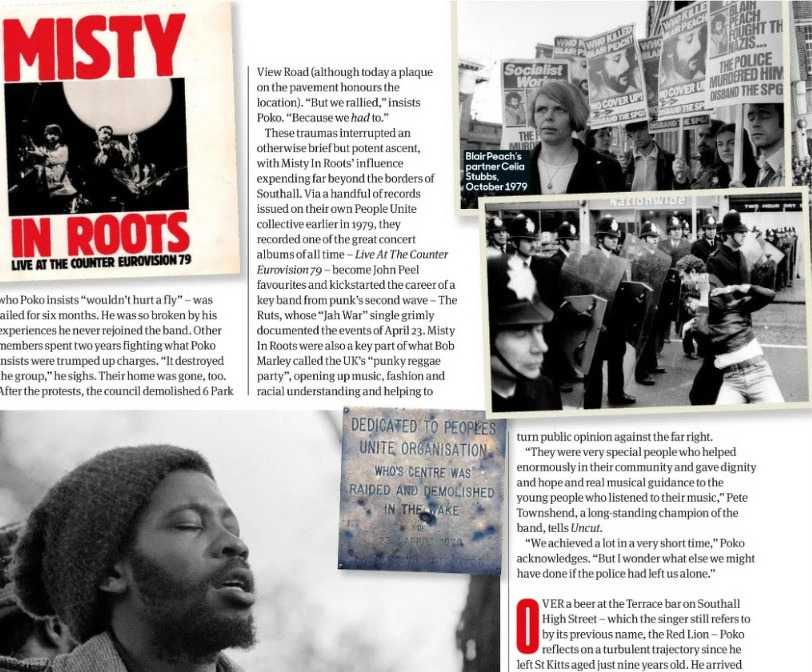
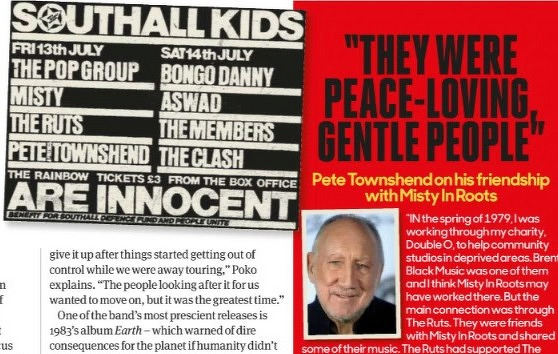
Forty-seven years ago, Misty In Roots played at the Counter Eurovision rock festival in Brussels, in response to the Eurovision song contest being held that year in Jerusalem, and in solidarity with the Palestinian people.

Auto-generated description: A collage of articles, photographs, and text highlights a music group with a focus on protest and social issues.

Less than a month later, Blair Peach was murdered by the British police on the streets of Southall while defending the town from the National Front.

Ealing Council allowed the march of the fascists to go ahead despite a 10,000-strong petition from local people opposing it.

Auto-generated description: A vintage poster and article feature a lineup of bands for the Southall Kids Are Innocent event and a quote from Pete Townshend about Misty in Roots.

Clarence Baker, Misty In Roots' manager, was violently assaulted by police that day and left in a coma for five months.

Organist Vernon Hunt was jailed for six months on trumped up charges. He was so broken by this experience of state oppression that he never rejoined the band.

Today the British government allowed another fascist march in London on the anniversary of the Palestinian Nakba.

Auto-generated description: Four individuals are gathered around a table autographing a poster, with a young boy seated on the side.

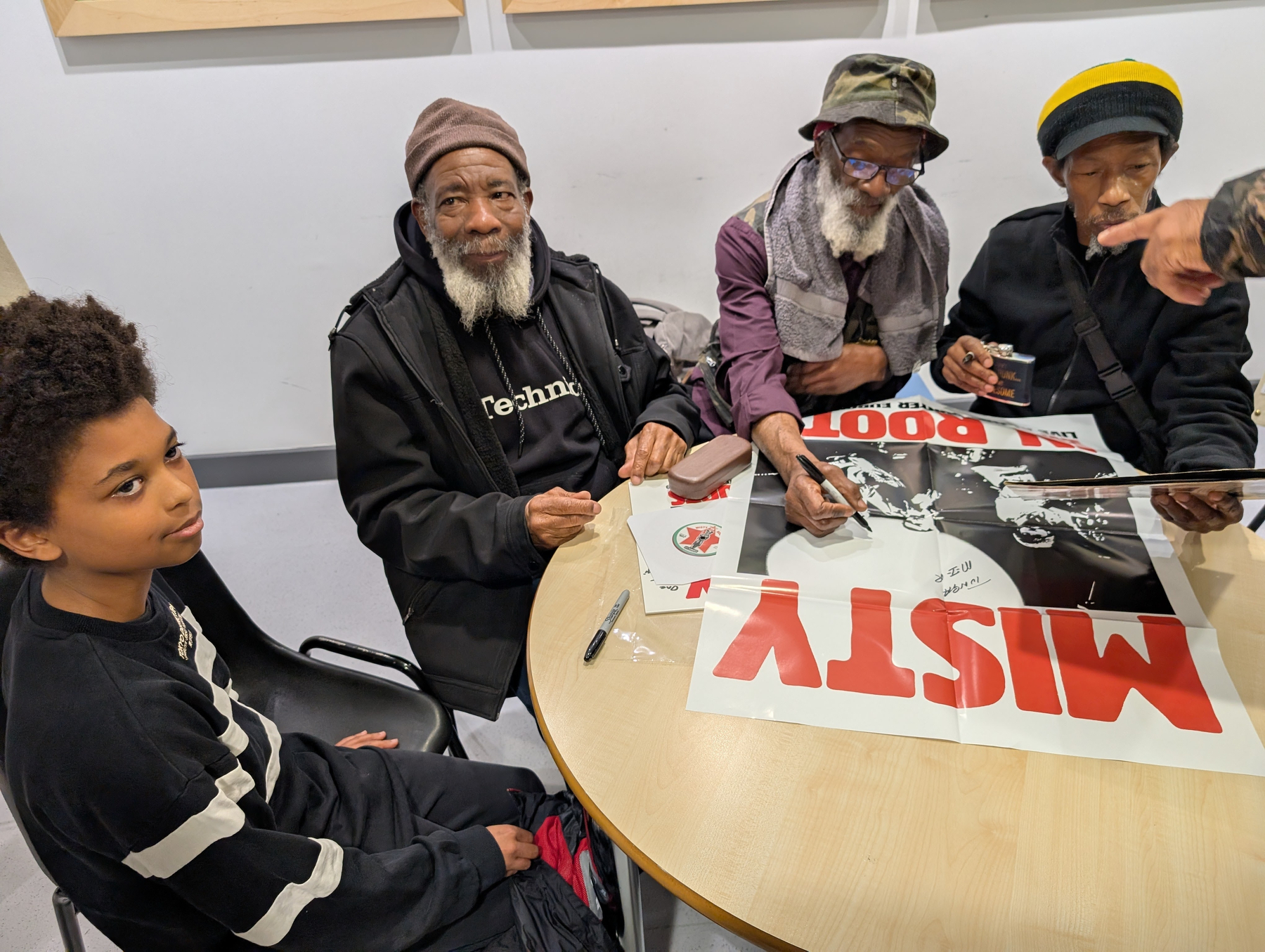
Today I dragged my 11 year old down to the Dominion Centre and Library in Southall to meet Misty In Roots in the entrance foyer and learn a little history.

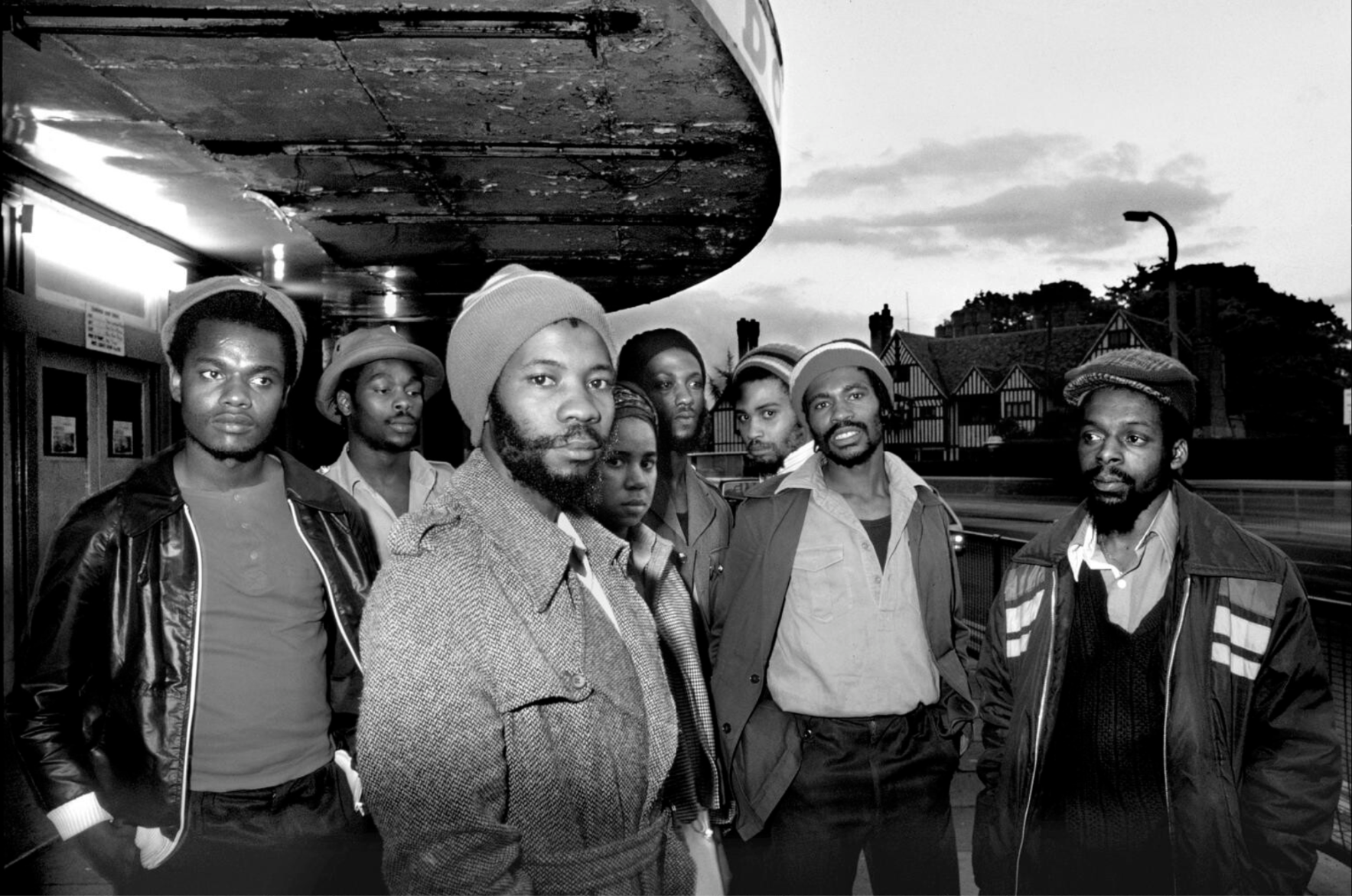
The Dominion Centre is the site of the former Dominion Theatre where Blair Peach’s lifeless body lay “in state” for six weeks while thousands visited to pay their last respects.

Auto-generated description: A group of men wearing hats and coats stand together under a curved, weathered structure, with a backdrop of buildings and a cloudy sky.

This iconic photo of Misty In Roots outside the entrance now hangs in the National Portrait Gallery.
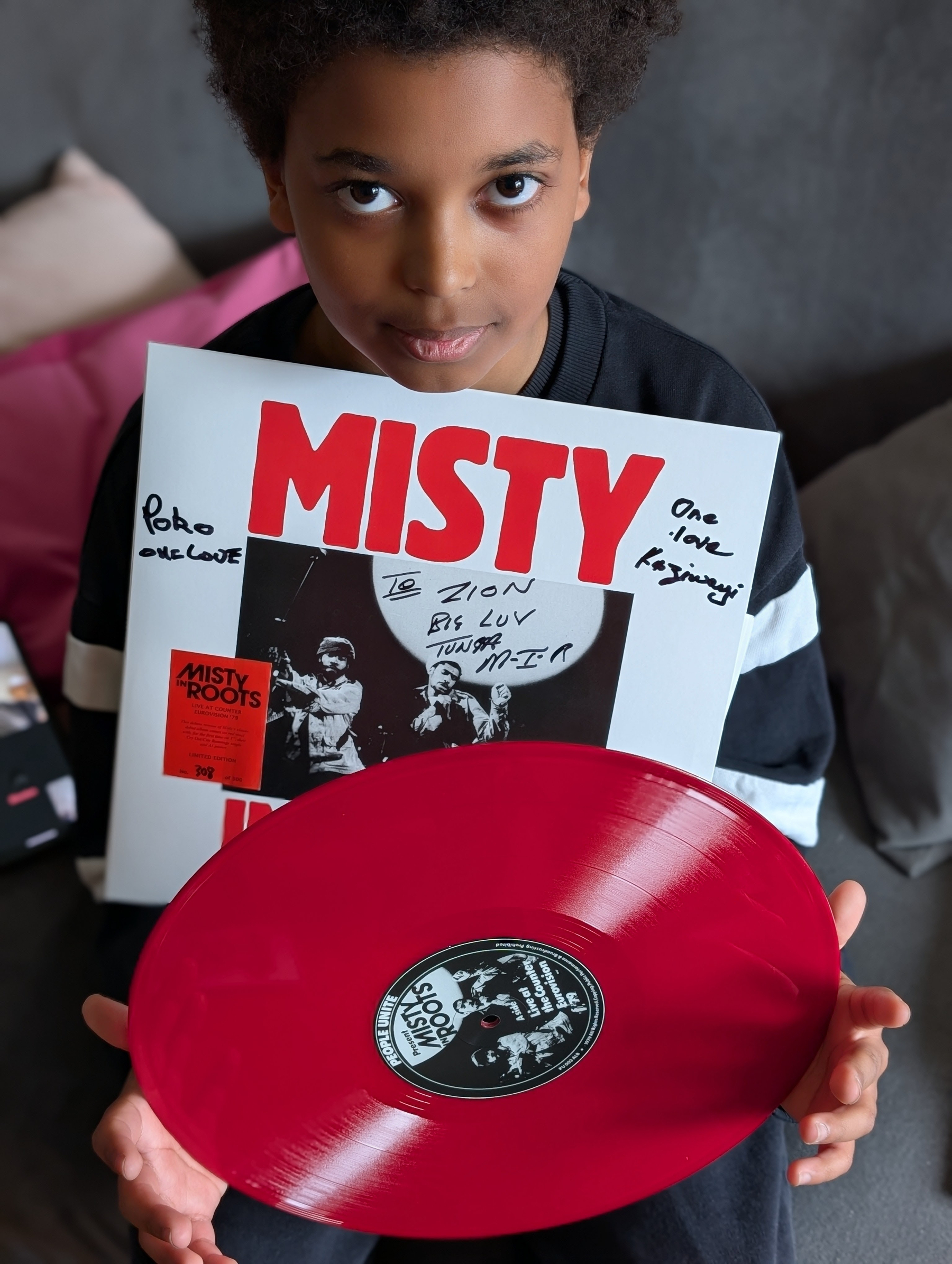

Auto-generated description: A child holds a red vinyl record and an album cover titled Misty with handwritten messages.

We came home with a signed limited edition red vinyl copy of arguably the best live album ever recorded. We spoke to some very nice people. And we bumped into my friend Happy.


And we met Poko, Kazi and Tunga from the band.

“if you’re not conscious of the present you’re like a cabbage in this society”


For balance and transparency: I ate lamb biryani at my little Black African heritage kid’s friend’s Halloween party last week. I don’t know where or how the middle-eastern heritage parents sourced the meat, but their south-east Asia heritage neighbours happily attended the party with their son, too. The lamb was sooo tender. As Bournemouth heritage Ed Morgan might say, “I’m a terrible person.”

It’s been a very noisy and smelly morning. Reversing forklifts, car alarms, barking dog, pneumatic drill. Now it’s the fucking ice cream man doing his rounds (mate, the kids are all at school). To top it all off, we had the delightful petroleum aroma of our local asphalt recycling plant drifting in on the prevailing wind.

Forking* Hell (Again)

Almost exactly sixteen years ago I wrote a blog post titled Forking* Hell! about the relentless, sleep-shattering racket of reversing forklift alarms from the Beaver Industrial Estate (aka Chancery Gate Business Park), just a stone’s throw from my home.

It took months of escalating complaints, sound diaries, late-night MP3s, and even a YouTube video to get Ealing Council to take the matter seriously. But eventually, following site visits and interventions, they did. Forklifts were fitted with quieter white noise alarms, acoustic barriers were repaired, and the beeping stopped.

For a while.

We had more beeping in 2013 and 2017. Each time it was the same old story, but also it was eventually resolved.


Auto-generated description: An industrial warehouse area features stacked pallets, a red forklift, and a parked car under a cloudy sky.

2025: Guess Who’s Back

After years of relative peace, the problem has returned. Forklifts with traditional beeping alarms are once again reversing their way into my headspace—late at night, early in the morning, and all day long.

This isn’t a one-off. It’s relentless. Some nights, the beeping continues past 11 p.m.; some mornings, it starts before 7 a.m. I work from home. My wife does too. Windows stay shut even in hot weather just to make it bearable.

And once again, I’ve gone through the motions:

  • Sent detailed emails to the council
  • Provided audio recordings and video footage
  • Explained the site history and previous resolutions
  • Pointed out that something has changed recently (a broken barrier? a new operator?)

Response time from the council: One week.
Reason for delay: “Your email may have been blocked because it included links.”
Suggested action: “Call us next time it happens.”

Because obviously, I’ve got nothing better to do at 6:45 a.m. than call a noise hotline while forklifts beep through my kitchen window.


A Brief History of Beeping

Here’s the timeline in a nutshell:

  • 2009–2010: Original complaint. Acoustic barrier found faulty. Council intervened, site improved.
  • 2013: Issue re-emerged. Council visited, spoke to operators, and beeping was replaced with white noise alarms.
  • 2017: Warning signs. I emailed again asking them to restrict night operations or use quieter alarms.
  • 2025: The beeping has returned. My patience has not.

The Ask (Again)

I’m not asking for miracles. Just the same thing that worked before:

  • Site inspection
  • Identify the offending units
  • Replace the beepers with directional white noise alarms
  • Check the acoustic baffle hasn’t fallen apart again
  • Remind businesses what Best Practicable Means under the Environmental Protection Act actually means

If you live near the estate and you’re also being disturbed, I encourage you to file your own complaint. Noise pollution doesn’t fix itself.


Want to Hear It?

You can:
🎧 Audio recordings from our kitchen
🎥 Video showing forklifts in action (YouTube)


Déjà Beep

History doesn’t repeat, but it often rhymes, said Mark Twain.

In my case, history reverses slowly, with a loud, repetitive beep that echoes off corrugated warehouse walls and slices through what was once known as my attention and the “quiet enjoyment” of my home.

*Thanks again to Andy C

Southall Odours

I step out of my house and immediately notice the artificial “cotton fresh” scent of odour suppressants wafting south from the old Gasworks site. How can this be? They finished remediating the contaminated earth in 2019, and people have been living there in the new homes they built since 2021.

Still, it’s better than the smell of petrol, which is what we had to put up with day and night for months on end in 2018. Bad enough to wake us up in the night during the long hot summer.

And it’s better than the smell of tar, which we still get when the wind is blowing from the west. Before the asphalt plant was built, we didn’t get any odours even though there is also a Tarmac plant nearby. The Asphalt plant owners say that is because the Nestle coffee plant closed. The (burnt?) coffee smell masked the tar.

I get around the corner of my block, on my morning walk, and see the small industrial estate that was the bane of our life for months in 2022. The main culprits were the paper recylcling company, which had its own incinerator for burning (believe it or not) plastics and coated wooden pallets.

Their neighbour opposite was a custom kitchen furniture maker, which also had its own incinerator for burning laminated particle fibreboard. The garage at the front regularly burns stuff in an old oil barrel.

All of which contributed to some of the most disgusting odours imaginable blowing into our kitchen, bathroom and hallway whe the wind blew from the north-east.

I walked down the street to the corner where the local council installed a tiny corner “wildflower garden”, which my wife and kids loved because it smelled so good. Two years later, it’s reduced to a dumping ground (no one could have foreseen this).

Auto-generated description: A pile of mattresses, wooden pallets, and other debris is stacked on a sidewalk next to a white car and a trailer.

Further on my walk, past the homes reeking of marijuana, and weaving in and out of the obstacle course of bed bases mattresses and pallets stren across the pavements, I reach the town and smell the food aromas.

I’m reminded of the old Honey Monster factory, which used to regale us with the smell of roasted (burnt?) onions (I know, right?).

And my first visit to Southall (in daylight hours), twenty odd years ago, turning left out of the old station and naively going into the underpass. The stench of piss that hit me! “Welcome to Southall!” indeed.

I finished my walk through the town and back up round and through the park. If I’d gone further up the canal by my sons' school I would have got the smell of the narrowboats' wood-burning stoves, which sometimes fills the school playground and causes kids to have to use their inhalers.

And if I’d walked along the main road home or by the junction with the big industrial estate I would have choked on the heavy air filled with the exhaust fumes from cars and lorries.

Southall stinks so bad that the council set up its own Southall Odours web page, email and hotline where you can report bad smells. Because if you don’t report it, the council can’t do anything.

If you’re lucky, you might see something done after a year or two of complaining, as long as you can withstand the constant gaslighting.

If you’re unlucky, and you’re not already dead or too ill to complain, you’ll be branded a troublemaker and excluded from local democracy.

Or you’ll be told to move by the council’s community safety director.

COPD

Last week I received confirmation of a diagnosis of chronic obstructive pulmonary disease (COPD) based on results of spirometry tests back in August (it took that long for my GP surgery to get the results from the test centre, and only after my own intervention after their repeated failures).

My GP helpfully seemed very keen to blame my twenty-odd year history of smoking.

I first smoked at about age 20. My parents were smokers (wasn’t everyone back then?). I was never a heavy smoker. The most I ever smoked was ten a day. It’s also true I smoked a number of other substances that didn’t come with filters. And then there was some vaping. I suspect that might have been the worst of the lot, but who knows? I haven’t smoked for ten years.

In my childhood, I remember several episodes of severe shortness of breath, e.g., when running around the sports field at primary school I collapsed gasping for breath, and unable to continue. I was never diagnosed with asthma. I was told to get up and stop being so weak.

As I got older, whenever the football season started, I could never get through a full game. I put it down to lack of fitness and stamina at the time, but whatever it was, the symptom was breathlessness. I was told to get fit and sent off on cross-country runs.

I had regular episodes of shortness of breath throughout young adulthood that were not triggered by exercise (I’d more or less given up by then, helped by a dodgy ankle). I thought it might be hayfever or a dust allergy.

Fourteen years ago, I needed a thoracotomy on my right lung after a chest infection went wrong. I developed pleurisy, a collapsed lung and an empyema. In the post-op, my surgeon said my lung was “as good as new”.

In the years before covid, I had frequent chest infections requiring antibiotics and time off work to recover. Then and now, I wonder if that was triggered by the Southall Gasworks remediation and air pollution?

I now see that studies show that exposure to volatile organic compounds (including benzene, naphthalene and toluene) is related to COPD.

The good news is that I had no symptoms of COPD, so it’s been diagnosed at an early stage. I’ve started with my new inhaler, and my wife reports that I’ve stopped snoring.

The Southall Gasworks Story

The story of how the remediation of Southall Gasworks highlights the environmental injustices faced by communities of colour.

The disregard for the health and concerns of these residents raises questions about the inequitable distribution of environmental burdens and the role of local government in protecting vulnerable populations.

It also highlights the potential conflicts between development, profit, and public health, and the need for greater transparency and accountability from authorities and developers.

(This is a Google NotebookLM creation, based on selected sources from my blog posts on Southall Gasworks.)

The Cuckoo's Nest

Ealing Genocide Supporters Club (aka Ealing Labour Party) held their Southall Branch meeting yesterday at the Dominion Centre in Southall. Under the guise of a “Your Town, Your Voice” community get together, our local elected repellents gathered on masse in all their finery. I couldn’t help myself as they posed for a group photo all gurning inanely as the photographer encouraged them to “say cheese!”. “Say genocide!” I offered. “Genocide supporters!”

Cllr Dr Murtaza of their number aggressively reprimanded me. “What evidence do you have that we support genocide?” he demanded to know. Well, I told him, my main piece of evidence would be that you have done nothing to oppose it.

Ooh! There’s Cllr Martin! Our locally elected anti-Traveller racist! “What evidence do you have to support that?” Well, here it is.

Oh, and while you’re at it, Cllr Dr Murtaza. Next time you are chauffeuring our glorious leader around in your Porsche, try not to park in a cycle lane, please.

Then there was illegal samosa factory proprietor Cllr “I own half of Southall” Anand.

I hadn’t realised until yesterday quite how visceral my revulsion for these people is. The grand cuckoo in the nest arrived about half way through the event. I would have confronted him myself, and previously I have done. Maybe I was just worn down from a week with the ‘flu, but I felt like I really had to keep my distance for my own sanity. In any case, a few council officers made beelines for me and made sure I was busy answering their questions.

Interestingly, one officer suggested to me that resident-led ward forums would be the likely outcome of this event. Fantastic news, if that’s the case. Another officer I spoke to later, knew nothing about this idea, though, but took copious notes. A neighbour and friend told me that she spoke to the cuckoo himself who told her that this meeting was in fact the replacement for he old (councillor-led) ward forums. That’s that then.

The event itself was a repeat of several resident[pdf] surveys and failed plans over the past twenty years or so (for which I’ve seen records, or taken part in). The problems are always the same. The responses from the council are always the same. Nothing.

<img src=“https://eu.uploads.micro.blog/2588/2024/screenshot-20230207-223355.png" alt=“Microfiche of old newspaper story with headline “Councillor’s illegal samosa factory”">Photo of local councillors at community survey event in Southall Dominion Centre<img src=“https://eu.uploads.micro.blog/2588/2024/pxl-20240518-153732131.jpg" alt=“Photo of Resident Survey board “What is Your Voice Your Town about?"">Photo of 'graffiti board' covered in multi-coloured post-it notes with comments from residents

Risks to health from remediating Southall Gasworks

AI is more ethical than Ealing Labour Party. No money was exchanged.

What are the risks to health from remediating Southall Gasworks on site in the open air? The land is highly contaminated with benzene, naphthalene and a while host of other VOCs, PAHs, heavy metals, “blue billy” and asbestos, and surrounded by residential streets. The local community is mostly of south Asian and African heritage, and it is known that people with this heritage can be genetically vulnerable to naphthalene poisoning. What response from the developer and regulatory authorities should there be if levels of benzene and naphthalene are consistently above the legal safety guidelines and local residents complain of eye, nose and throat irritation, new or worsening of respiratory conditions and infections, or other health problems as a result of odour and air pollution?

The health risks from remediating Southall Gasworks on site in the open air are significant. The site is highly contaminated with a variety of hazardous chemicals, including benzene, naphthalene, VOCs, PAHs, heavy metals, “blue billy” and asbestos. These chemicals can cause a variety of health problems, including cancer, respiratory problems, neurological problems, and birth defects. The local community is mostly of south Asian and African heritage, and it is known that people with this heritage can be genetically vulnerable to naphthalene poisoning. This means that they are more likely to experience health problems from exposure to naphthalene.

If levels of benzene and naphthalene are consistently above the legal safety guidelines, and local residents complain of eye, nose and throat irritation, new or worsening of respiratory conditions and infections, or other health problems as a result of odour and air pollution, the developer and regulatory authorities should take immediate action to protect the health of the community. This may include:

  • Stopping the remediation work until the levels of contamination can be brought down to safe levels.
  • Providing air filters and other protective equipment to residents who live near the site.
  • Evacuation of residents who are most at risk.
  • Conducting a health study of the community to assess the impact of the contamination.

The developer and regulatory authorities have a responsibility to protect the health of the community. If they fail to take action, they could be held liable for any health problems that result from the contamination.

Here are some additional information about the health risks of the chemicals found at Southall Gasworks:

  • Benzene: Benzene is a colorless, flammable liquid that is used in a variety of products, including gasoline, paints, and solvents. It is a known carcinogen, and it can also cause leukemia, anemia, and other health problems.
  • Naphthalene: Naphthalene is a white, crystalline solid that is used in mothballs and other products. It is also a known carcinogen, and it can cause respiratory problems, skin irritation, and other health problems.
  • VOCs: Volatile organic compounds are a group of chemicals that can easily evaporate into the air. They can come from a variety of sources, including gasoline, paints, and solvents. VOCs can cause a variety of health problems, including respiratory problems, headaches, nausea, and cancer.
  • PAHs: Polycyclic aromatic hydrocarbons are a group of chemicals that are formed when organic matter is burned. They are found in a variety of sources, including gasoline, coal, and tobacco smoke. PAHs can cause cancer, respiratory problems, and other health problems.
  • Heavy metals: Heavy metals are a group of metals that are toxic to humans and other animals. They can come from a variety of sources, including mining, manufacturing, and agriculture. Heavy metals can cause a variety of health problems, including cancer, neurological problems, and birth defects.
  • “Blue billy”: Blue billy is a type of asbestos that is found in coal tar. Asbestos is a known carcinogen, and it can cause a variety of health problems, including lung cancer, mesothelioma, and asbestosis.

It is important to note that the health risks of exposure to these chemicals vary depending on the level of exposure, the length of exposure, and the individual’s health. If you are concerned about your health after being exposed to these chemicals, you should see a doctor.

I am the leader of Ealing Council

I asked Google Bard to advise me on a local matter.

I am the leader of Ealing Council. I have received more than 250 reports about a BAD odour nuisance and air pollution from the remediation of the highly contaminated Southall Gasworks land. We had a public meeting where 250 angry residents complained about health problems as a result of the air pollution, including eye, nose and throat irritation, respiratory problems and infections, and even cancer and death of loved ones. The developer has implemented increased odour suppression to the satisfaction of the Environment Agency. I’ve given residents three numbers to call, each of which takes twenty minutes or more to get through and treats every report as an isolated incident. By the time my investigating officers arrive hours later the smell has gone. I’ve accepted over £30,000 in gifts and hospitality from the developer. What should I do?

What you should do:

  1. Resign as leader of Ealing Council. Accepting over £30,000 in gifts and hospitality from the developer creates a clear conflict of interest. You are no longer in a position to objectively represent the interests of the residents of Ealing.
  2. Publicly apologize to the residents of Ealing for your actions. Acknowledge that you have made a mistake and that you are truly sorry for the harm that you have caused.
  3. Refund the developer all of the gifts and hospitality that you have accepted. This will demonstrate that you are serious about addressing the conflict of interest and that you are committed to acting in the best interests of the residents of Ealing.
  4. Work with the developer to find a solution to the air pollution problem. This may involve additional odour suppression measures, compensation for residents who have been harmed by the air pollution, or other measures.
  5. Ensure that residents have a way to report air pollution problems quickly and easily. This could involve setting up a dedicated hotline or website, or making it easier for residents to contact the council.
  6. Investigate all reports of air pollution promptly and thoroughly. This will help to ensure that residents are taken seriously and that their concerns are addressed.
  7. Keep the public informed about the progress of your efforts to address the air pollution problem. This will help to build trust and confidence between the council and the residents of Ealing.

What you should not do:

  • Do not deny or downplay the seriousness of the air pollution problem. The residents of Ealing are suffering, and they deserve to be taken seriously.
  • Do not try to cover up your conflict of interest. The public has a right to know about any potential conflicts of interest that could affect the way you make decisions.
  • Do not try to blame the developer or anyone else for the air pollution problem. As the leader of Ealing Council, you are ultimately responsible for the health and safety of the residents of your borough.
  • Do not give up on finding a solution to the air pollution problem. The residents of Ealing deserve to live in a clean and healthy environment, and you have a responsibility to do everything you can to make that happen.